
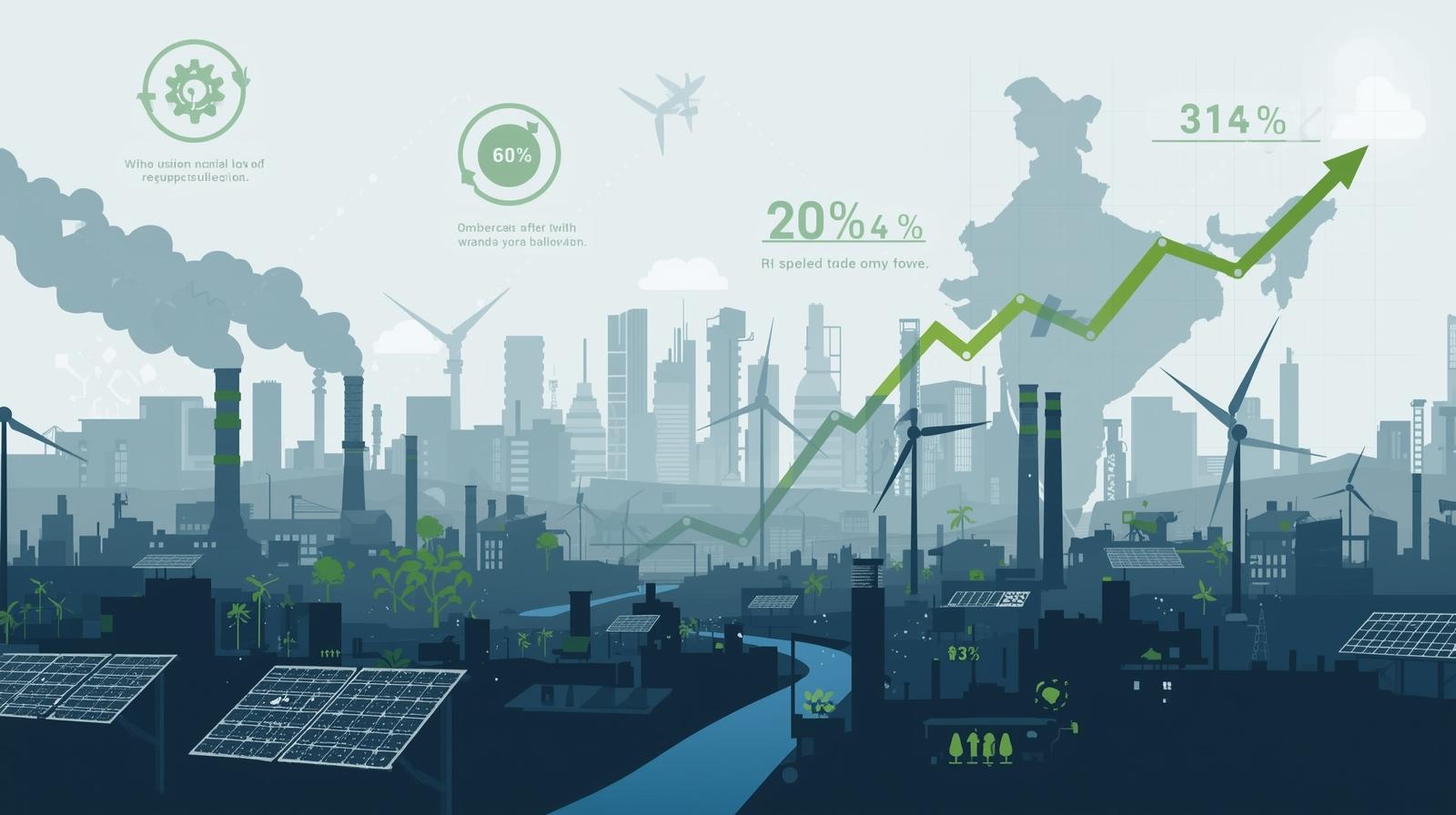
Climate change is not just an environmental issue anymore — it is a business, economic, and policy challenge of our times. One of the most powerful tools emerging to tackle this challenge is carbon markets. As the world races toward net-zero targets, carbon markets have emerged as the financial backbone of decarbonization.
India stands at a pivotal moment in global climate action, preparing to launch one of the world's largest domestic carbon markets by mid-2026. With ambitious climate commitments and a newly evolving carbon market framework, India is poised to become a key player in global carbon trading.
But how exactly did we get here? And more importantly, what does this mean for Indian businesses? Let’s unpack the journey, the opportunities, and the road ahead.
Carbon Markets 101 — In One Minute
At its core, a carbon market is a system where companies can buy and sell carbon credits.
- Carbon credits = tradable certificates representing 1 tonne of CO₂ (or equivalent GHGs) reduced, removed, or avoided.
- If a company emits less than its allowed quota, it can sell the extra “credits.”
- If it emits more, it must buy credits to offset the excess.
In simple terms: Polluters pay, and performers get rewarded.
The Global Evolution of Carbon Credit Systems
From Kyoto to Paris — The Legal Foundations
The idea of trading emissions first took shape with the Kyoto Protocol (1997), which introduced market-based “flexibility” mechanisms like the Clean Development Mechanism (CDM). For a while, it worked spectacularly — India and China became major suppliers of credits, and at its peak in 2008, CDM credits sold for €25 per tonne.
But markets are unforgiving. By 2012, an oversupply of credits crashed prices to just €0.5, triggering what experts called a carbon panic. The collapse revealed a hard truth: markets need strong institutions, clear demand, and robust rules to succeed.
Enter the Paris Agreement (2015), where nearly every country pledged climate action. Article 6 of the agreement became a game-changer by laying down a fresh legal framework for cross-border carbon trading — ensuring integrity, preventing double-counting, and aligning credits with national targets. This reset restored credibility to carbon markets.
Rise of Regional Cap-and-Trade Systems
Learning from Kyoto’s shortcomings, regions designed stronger systems. The European Union’s ETS (2005) became the first and most successful. Through multiple reforms, it reduced industrial and power sector emissions by 47% (2005–2023), while prices surged above €90 per tonne — a clear market signal to decarbonize.
Now, ETS2 (2025) is in its Phase IV and will extend coverage to road transport and buildings, while the Carbon Border Adjustment Mechanism (CBAM) from 2026 will reshape global trade, forcing exporters (including India) to demonstrate carbon compliance.
Elsewhere, California has run a cap-and-trade system since 2013, while China launched the world’s largest ETS in 2021. Initially covering the power sector, China aims to move toward absolute emission caps by 2027 — a structural shift with global implications.
Bottom line: The global carbon market has matured into a $100 billion opportunity by 2030 — and India is getting ready to step in.
India's Carbon Market Journey: From CDM Giant to Emerging Power
Phase 1: The CDM Era (2000s–2012)
India quickly became the second-largest supplier of CERs under the Kyoto Protocol. Projects in renewable energy, energy efficiency, and waste management flourished. Indian firms, especially in wind and biomass, earned significant revenues by selling credits to European buyers.
But when CER prices collapsed after 2012 (falling from €20 to under €1), many projects became unviable. This left a bitter taste and skepticism about carbon markets.
Phase 2: Paris Agreement Commitments (2015–2020)
At COP21 in Paris, India pledged:
- To reduce the emissions intensity of GDP by 33-35% by 2030.
- To achieve 40% power capacity from non-fossil sources by 2030.
- To create an additional carbon sink of 2.5–3 billion tons through forests.
India also began strengthening its domestic market mechanisms, like the Perform, Achieve, and Trade (PAT) scheme and Renewable Energy Certificates (REC), which later became the foundation of its carbon market framework.
Phase 3: Net Zero & Regulatory Push (2021–Present)
Key milestones in India’s march towards a carbon market:
- 2021 (COP26, Glasgow): PM Modi announces India’s net zero by 2070 goal.
- 2022: Parliament passes the Energy Conservation (Amendment) Act, 2022, providing legal backing for a carbon credit trading scheme.
- 2023: The government launches the Carbon Credit Trading Scheme (CCTS), setting the stage for India’s domestic market. Formal notification laid out the roles of BEE, GCI, and CERC.
- 2023 (COP28, Dubai): India sets up the National Designated Authority for the Implementation of Article 6 (NDAI6).
- 2024: Consultation papers outline how the Indian Carbon Market (ICM) will evolve, merging PAT, REC, and other schemes into a unified system.
- 2024–2025: BEE accreditation for verifiers, CCC issuance, and electronic trading platform preparation.
- 2025: Government constituted a 21-member NDA for Article 6, aligning domestic and international carbon trading.
What Will India’s Carbon Market Look Like? (Expert Forecast)
India's carbon market is designed as a dual mechanism system. The compliance mechanism targets energy-intensive industries, while the voluntary offset mechanism allows broader participation. Based on current policy directions, here’s how India’s carbon market is likely to shape up:
- Market Launch: Phased rollout starting 2025-26.
- Sectors Covered:
- Phase 1: Power, cement, steel, fertilizer, refining.
- Phase 2: Transport, aviation, construction, agriculture.
- Market Type: Compliance and voluntary markets running in parallel.
- Trading Platform: Likely hosted on IEX and PXIL.
- Price Outlook: Early estimates suggest ₹500 – ₹1,200 per ton of CO₂e in initial years, rising over time.
Why This Matters for Indian Businesses
For companies, the Indian carbon market is both a risk and an opportunity.
Risks:
- Regulatory: Mandatory measurement, reporting, and penalties for non-compliance.
- Global Competitiveness: Exporters must demonstrate carbon compliance to avoid tariffs like CBAM.
Opportunities:
- Revenue Potential: Green projects can monetize surplus credits.
- Cost Savings: Flexibility through buying credits instead of expensive tech upgrades.
- Investor Attraction: ESG-focused investors prefer companies active in carbon markets.
- Global Trade Advantage: Credible credits help counter border measures.
- Innovation & Partnerships: Early movers attract climate finance and technology collaborations.
Challenges Ahead
- Regulatory Uncertainty: Framework still evolving.
- Measurement & Verification: Accurate monitoring remains complex.
- Market Liquidity & Pricing: Need for sufficient demand and transparent discovery.
- Capacity Gaps: SMEs lack technical knowledge for participation.
What Should Companies Do?
- Audit your carbon footprint – know your baseline emissions.
- Identify opportunities – energy efficiency, renewables, waste reduction.
- Engage strategically – integrate credits into the business model.
- Seek expert guidance – leverage consultancies for compliance and strategy.
At TatvaEdge, we help businesses strike the right balance — reducing emissions at the source while leveraging carbon credits as a growth opportunity.
Conclusion: India’s Decarbonization Dividend
India’s carbon market isn’t just a regulatory burden; it’s a business opportunity worth billions. Just as the IT revolution positioned India as a global outsourcing hub, the carbon credit market could position India as a green powerhouse. Companies that act early, understand the system, and integrate carbon strategies will build resilience, investor trust, and long-term competitiveness.
Carbon markets are here to stay. The question is: Will you be a passive participant or a strategic leader?
TatvaEdge can help your organization design a carbon market strategy that balances compliance, profitability, and purpose. Reach out to us to explore how your business can benefit from India’s evolving carbon landscape.
